
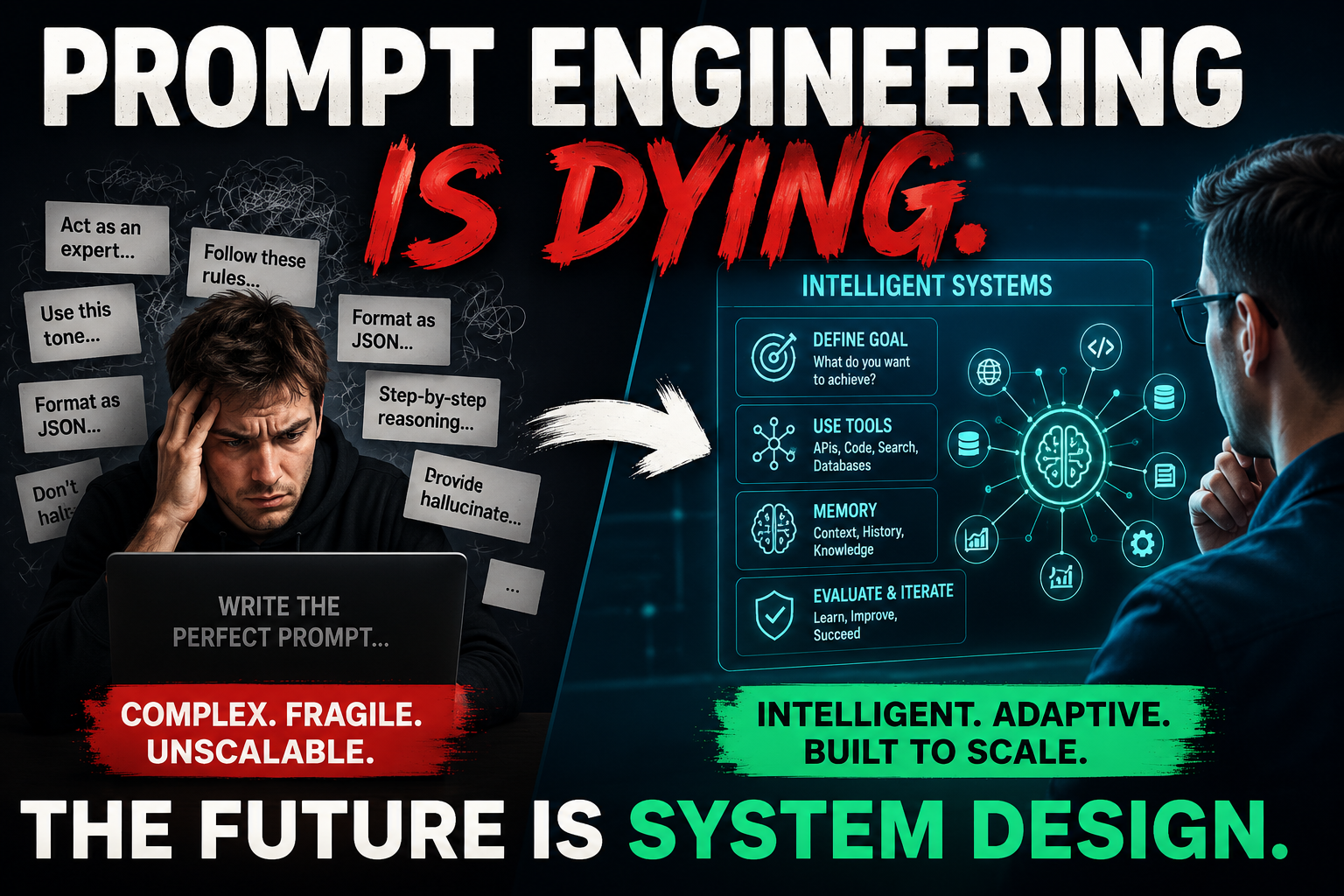
The Obsolescence of the Prompt: Why the Cognitive Era Demands System Design Over Linguistic Micromanagement
An analysis of the structural shift from manual natural-language instruction to automated, agentic system architecture.
The Obsolescence of the Prompt: Why the Cognitive Era Demands System Design Over Linguistic Micromanagement
An analysis of the structural shift from manual natural-language instruction to automated, agentic system architecture.
The rapid ascension of prompt engineering from a niche software workaround to the most highly publicized tech skill of the decade has met a sudden and decisive counter-narrative. In a provocative industry analysis, technology analyst WhyPratiik argues that the era of the manual, highly complex prompt is drawing to a close. The thesis asserts that the practice of crafting increasingly elaborate, natural-language instructions is not a permanent new discipline, but rather a temporary scaffolding. It was a manual patch designed to prop up the fundamental limitations of early, stateless large language models (LLMs). As these systems mature, the cognitive load is shifting from the user's input window into the underlying software architecture itself.
To understand this transition, it is necessary to examine the architectural deficits of early generative AI tools and trace how the industry is moving from procedural, natural-language "incantations" toward declarative, system-level design. WhyPratiik's work suggests that the future of working with artificial intelligence looks less like micromanaging text strings in a blank chat box and more like engineering robust, multi-agent pipelines where natural language acts as an interface of high-level intent rather than a fragile compiler.
The Stateless Engine and the Scaffolding of Prompt Engineering
The emergence of prompt engineering as a popular phenomenon in late 2022 was directly tied to the launch of consumer-facing models like ChatGPT. While these engines displayed remarkable linguistic fluency, they arrived with a critical architectural limitation: they were fundamentally stateless. In computer science, a stateless system is one that treats each request as an independent transaction, completely isolated from previous interactions.
When a user sent a query to an early LLM, the model possessed no native memory of a prompt sent moments prior. It could not plan multiple steps ahead, query external databases to verify its assertions, or access live mathematical tools. It functioned as a massive, closed mathematical prediction engine, frozen in the temporal boundary of its training data.
This lack of infrastructure created massive friction for users seeking professional, predictable outputs. If an analyst required a model to evaluate a financial spreadsheet using a specific corporate valuation framework, they could not simply ask for the evaluation. Instead, they had to manually supply the framework, define the structure of the output, dictate the tone, and feed the raw data into the context window with every single run.
Prompt engineering emerged to solve this friction. It became a manual scaffolding where natural language was used to:
- Inject external context that the model lacked natively.
- Force step-by-step reasoning sequences to prevent logical hallucinations.
- Establish rigid roleplay parameters (e.g., "Act as a senior forensic accountant") to prime the model's output distribution.
- Dictate precise formatting constraints, such as JSON structures or markdown headings.
In essence, human operators were acting as the external memory and cognitive coordinators for an engine that lacked its own internal operating system.
The Mechanics of In-Context Learning and the Noise of Over-Constraint
The fragility of early prompting techniques becomes clear when analyzing the underlying mechanics of how these models process input. When a user constructs a massive system prompt complete with formatting instructions, rules, and few-shot examples, the model does not undergo true learning. Instead, the process relies on a phenomenon known as in-context learning.
Mathematically, a traditional stateless language model maps a prompt vector to a response vector through a static parameter space :
In this formulation, the model's weights remain entirely unchanged. The elaborate prompt is simply used to guide the model's attention mechanism, mathematically constraining the token-prediction probability distribution to favor a specific subset of its pre-existing training data.
Because this process relies entirely on the mathematical weights of the attention mechanism, it is highly sensitive to minor variations. Changing a single word, a punctuation mark, or even the order of instructions can shift the attention weights dramatically. This explains the explosion of online "cheat sheets" and prompt formulas in late 2022 and early 2023; users were attempting to find the exact linguistic sequence that would reliably constrain a probabilistic system to produce a deterministic result.
However, as frontier models have scaled, this manual hand-holding has reached a point of diminishing returns. WhyPratiik points out that modern models have internalized more of the semantic relationships between a user's stated goal and the professional standards required to execute it. If a user asks a capable modern model to design a scalable database schema, the model does not require a paragraphs-long fictional biography of a database administrator to perform well. It already knows that a professional database schema requires indexing strategies, normalization, foreign key constraints, and security considerations.
Furthermore, overloading a model with a massive, over-constrained system prompt can introduce severe semantic noise. When a model's attention mechanism must distribute its mathematical weight across dozens of competing rules—such as being simultaneously "concise but highly detailed," "creative but strictly factual," and "conversational but formal"—the system is forced to make mathematical trade-offs. The resulting output often becomes sterile, compromised, or mechanically stiff.
As shown in the diagram above, when a user injects contradictory constraints into a single prompt window, the attention mechanism must distribute its mathematical weights across competing objectives. The red dashed lines illustrate the semantic tension between directives like "Concise" and "Detailed," or "Creative" and "Factual." Rather than optimizing for the core objective, the model is forced to resolve these local linguistic conflicts, resulting in compromised performance.
The Paradigm Shift to Agentic AI and Declarative Design
The limitations of static prompting in standalone chat interfaces have prompted a broader structural shift in software engineering. The industry is transitioning from a manual, procedural interaction model to an agentic, declarative system model. WhyPratiik frames this as the difference between "talking to AI" and "building AI systems."
In a traditional procedural paradigm, the human operator must define every step of the execution path. This is equivalent to writing a highly detailed recipe in natural language:
- Read the input document.
- Identify the core financial metrics.
- Compare these metrics against the historical values provided in Section 4.
- Format the output as a Markdown table.
If the model encounters an unexpected edge case or a format mismatch at step three, the execution chain breaks entirely.
In contrast, the declarative paradigm allows the user to define the desired outcome (the "what") and rely on the underlying system architecture to coordinate the execution path (the "how"). This is highly analogous to Structured Query Language (SQL) in database management. When an engineer writes a SQL query, they do not write low-level code instructing the database engine how to traverse physical sectors on a solid-state drive or how to allocate memory buffers:
sql SELECT customer_name, lifetime_value FROM customers WHERE lifetime_value > 50000;
The database's internal query optimizer determines the most efficient retrieval path.
This declarative shift is realized through agentic AI systems. An AI agent is not a passive language model waiting for a prompt; it is a software design pattern that wraps a core LLM inside an active, stateful execution loop.
One of the foundational design patterns enabling this autonomy is the ReAct (Reason and Act) framework. In a ReAct loop, the agent transitions through a structured cycle of reasoning, acting, and observing. Instead of generating a single, static response block, the agent can dynamically evaluate its progress toward a declarative goal.
Let the state of the agent system at time step be represented as . The transition function updates this state based on the previous state , the action taken , and the resulting environmental observation :
This state progression can be visualized as a continuous, closed feedback loop:
As illustrated in the ReAct loop, the core LLM acts as an orchestrator rather than a passive text generator. It generates a reasoning trace, decides to execute an action (such as writing a Python script or querying a database), observes the result of that action, and integrates the new information back into its context window to determine its next step.
This architectural loop mitigates the fragile "one-shot" generation problem. If an agentic system encounters a database error during data analysis, it does not crash or generate a hallucinated response. It reads the error log, rewrites the SQL query, and retries the action. The user remains entirely shielded from this low-level loop; they simply receive the finalized, verified analysis.
The Skill Stack of the Post-Prompting Era
If natural-language prompts are moving downward in the software stack, the role of the AI practitioner must shift upward. WhyPratiik argues that the value in the AI ecosystem is rapidly consolidating around system design, orchestration, tool integration, and evaluation frameworks.
The emerging technical skill stack is built upon four primary pillars:
Agent Orchestration
Instead of attempting to construct a single, massive prompt that forces one model instance to handle multiple, conflicting tasks, system architects are building networks of specialized agents. An orchestration layer coordinates these components, establishing communication protocols, managing state transfers, and defining handoff procedures.
For instance, an enterprise content-generation pipeline might deploy:
- A Planner Agent that breaks down a source document into core arguments.
- A Research Agent that queries internal vector databases to retrieve supporting evidence.
- A Writer Agent optimized for stylistic fluency to draft the copy.
- An Evaluator Agent that cross-references the draft against strict factual constraints and style guides.
Managing the flow of data between these entities resembles organizational management more than traditional programming. Architects must design routing logic, determine when an agent should escalate an issue to a human in the loop, and construct fallback routines for when an agent fails to complete its assigned sub-task.
Tool Integration and Memory Management
Models are fundamentally constrained by their context windows and their inability to interact with the external world. Bridging this gap requires the development of robust application programming interfaces (APIs) and sophisticated memory systems.
Memory management is particularly complex. An agent cannot simply append every past interaction to its context window; doing so introduces semantic noise, increases latency, and quickly exhausts token budgets. System designers must build tiered memory architectures:
- Short-term memory: Stored in active working context, representing the immediate steps of the current task.
- Long-term memory: Implemented via vector databases, semantic search, and summarization loops, allowing the system to retrieve historically relevant data only when the context of the current task demands it.
Determining what information to write to long-term storage, how to index it semantically, and when to prune outdated memories is a complex engineering challenge that cannot be solved with a clever prompt adjective.
Sophisticated Evaluation Frameworks
Because language models are probabilistic, testing them poses a unique challenge. Traditional software engineering relies on deterministic assertion testing: input must always yield output . In a probabilistic system, a model may solve the same problem in three different ways across three different runs, all of which are valid.
To safely deploy these systems in production, developers are building automated evaluation frameworks. A prominent technique is "LLM-as-a-judge," where a highly capable, closed-source model evaluates the outputs of smaller, specialized open-source models against strict rubric criteria. These frameworks run automated regression testing, simulate edge-case user queries, measure latency, and monitor for behavioral drift after a model update.
Deep Domain Expertise
The transition to agentic systems highlights a critical truth: you cannot evaluate the quality of an AI-generated output if you do not understand the domain yourself.
Whether the field is corporate finance, healthcare compliance, legal contract analysis, or creative writing, deep domain expertise is required to build the evaluation rubrics, design the constraints, and determine what constitutes a "good" or "safe" result. The value is shifting from the mechanics of asking to the discipline of verifying.
Source-First Architecture: The Real-World Application
The practical implications of this transition are already finding form in modern software design. A notable example is the content automation platform Narratora.
Traditional generative writing tools present the user with a blank text box, placing the burden on the user to craft a complex prompt describing the desired document type, tone, target audience, structural rules, and source data. Narratora, conversely, adopts a "source-first" approach.
The architecture is designed around Smart Source Detection. When a user uploads a source document—such as a PDF of a clinical trial, an interview transcript, or an earnings report—the system automatically analyzes the document's structure and content type. It then recommends a tailored workflow based on the source material itself.
As contrasted in the diagram, a source-first architecture removes the need for manual, natural-language prompt engineering. Instead of forcing the user to act as a system architect in a blank text field, the platform abstracts the prompt layer behind a clean User Interface (UI). The user adjusts structured parameters—such as target audience level, tone, and output length—while the underlying system translates these decisions into optimized, programmatically structured prompts that are injected directly into the agentic workflow.
This design pattern significantly reduces "source drift"—the tendency of generative models to introduce outside, unverified information. Because the generation process is programmatically anchored to the validated source material, the system is constrained by architecture rather than language, creating a far more stable and predictable enterprise solution.
The Assembly Language of the Cognitive Era
The transition away from manual prompting does not mean that prompts are disappearing entirely. WhyPratiik offers a highly instructive analogy by comparing prompts to Structured Query Language (SQL) and Object-Relational Mappers (ORMs).
When ORMs were introduced to software development, they allowed programmers to interact with relational databases using their native, object-oriented programming languages (such as Python or Java) rather than manually writing raw SQL queries. Some industry observers predicted that SQL would become obsolete.
It did not. Instead, SQL was pushed lower down the development stack. Today, the vast majority of database interactions are handled automatically by ORMs because it is faster, cleaner, and significantly less prone to syntax errors. However, when a developer encounters a highly complex query, a major database migration, or an intense performance bottleneck, a deep, low-level understanding of raw SQL remains incredibly valuable.
Prompt engineering is undergoing an identical shift. It is becoming the low-level assembly language of the cognitive era. The average user will no longer write multi-page text prompts in empty chat boxes. Instead, they will interact with software systems that manage the prompts internally. Prompt construction is being standardized, automated, and embedded within broader software frameworks.
For the millions of early adopters who spent the last several years curating prompt libraries, mastering few-shot structures, and studying how models respond to linguistic cues, this effort was not wasted. These activities provided a crucial, intuitive understanding of how neural networks process context, resolve semantic conflicts, and navigate probabilistic logic.
However, the abstraction layer has permanently shifted. The critical questions of the next decade of artificial intelligence are no longer linguistic:
- It is no longer: What is the exact adjective that will make this model write in a professional tone?
- It is now: What is the objective? What source data must be retrieved? Which tools must the agent access? How will memory persist across execution steps? And how will we programmatically evaluate the validity of the final output?
WhyPratiik's analysis provides a reassuring conclusion: prompt engineering is not dying because generative AI has failed. It is dying because the software surrounding generative AI is finally starting to work the way we always wanted it to. We are leaving behind the era of fragile, manual incantations and entering a mature phase of system design—one where human intent is directed, not micromanaged, and where the true power of cognitive computing is realized through robust, predictable, and scalable architectures.
Turn your sources into content like this
Narratora builds publish-ready scripts, briefs, and reports from your uploaded material.
Start Your 5-Day Trial — $1/Day