
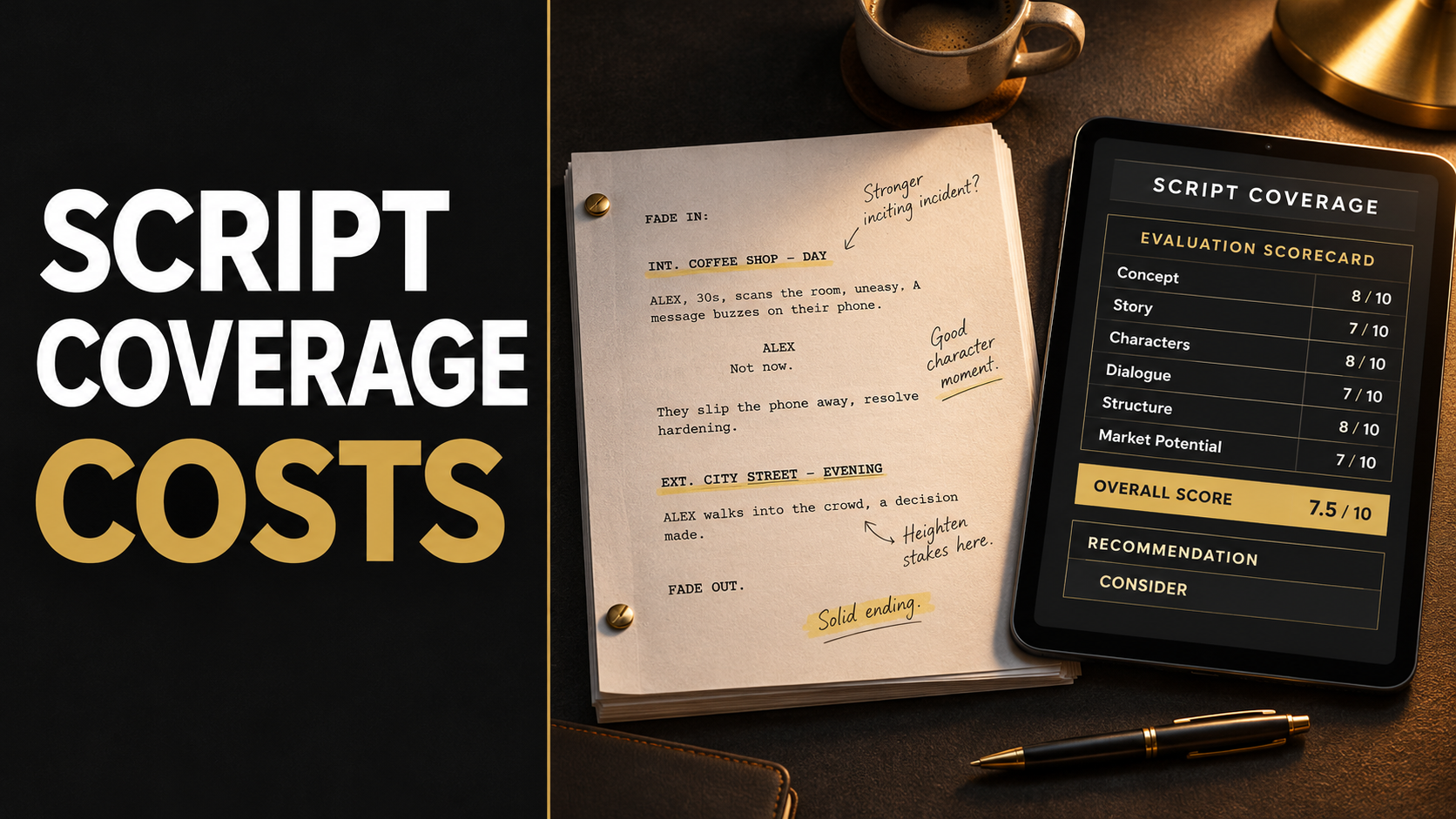
How Much Does Script Coverage Cost in 2027? AI vs. Professional Readers
Compare published script coverage prices, calculate the effective cost of AI reports, and decide when professional human feedback is worth your budget.
Paying for screenplay feedback is easy. Knowing which feedback deserves your money takes more thought.
If you’re budgeting for script coverage in 2027, the latest verified examples provide a useful starting point. Public prices checked on November 6, 2026 included a $99 full-script read from an industry reader, feature development notes at $149–$249, and expanded human coverage packages at $199–$449. These are published examples, and providers may change their prices before or during 2027. Stage 32 · Script Reader Pro
AI coverage uses a different pricing model. Some services charge a monthly subscription with a screenplay allowance. Narratora offers a $5 five-day trial that includes 40 credits and two premium outputs of your choice, with Professional Script Coverage among the available options. Narratora trial
The right choice depends on your draft, your budget, and the question you need answered. An early draft may benefit from an organized first pass that identifies revision priorities. A polished screenplay approaching an important submission may justify a human reader with relevant genre experience.
Here’s how to compare the costs and decide where to spend.
What are you paying for when you buy script coverage?
Script coverage is a written evaluation of a screenplay. A package may include a synopsis, comments on story and characters, a scorecard, development recommendations, or an overall verdict such as Pass, Consider, or Recommend.
Before comparing prices, establish the purpose of the report.
Coverage prepared for a producer may help them decide whether a screenplay deserves further attention. Feedback purchased by a writer may focus more closely on developing the next draft. Both can discuss strengths and weaknesses, but the amount of practical revision guidance can vary.
Read the package description and inspect a sample. Look for answers to three questions.
- Does the reader explain what they understood the story to be?
- Do the notes identify specific choices and their effect on the reading experience?
- Will the report help you decide what to change next?
A long report can still leave you uncertain. A concise report that identifies the central structural problem may give you weeks of productive rewriting.
Script coverage prices at a glance
The following examples were checked on November 6, 2026.
| Service and package | Published price | Scope |
|---|---|---|
| Stage 32 industry-reader coverage | $99 per script | Full feature or TV script read with 3–5 pages of feedback |
| Stage 32 feature development notes | $149 per script | Two pages of executive development notes |
| Stage 32 expanded feature development notes | $249 per script | 3–5 pages of executive development notes |
| Script Reader Pro Classic | $199 per feature script | Four pages of notes, genre specialist selection, scorecard, and three follow-up questions |
| Script Reader Pro Advanced | $269 per feature script | Eight pages of notes and additional package benefits |
| Script Reader Pro Deluxe | $449 per feature script | Twelve pages of notes and additional package benefits |
| Greenlight Coverage Basic | $75 per month | AI coverage for up to two screenplays monthly |
| Greenlight Coverage Essential | $129 per month | AI coverage for up to five screenplays monthly |
| Narratora five-day trial | $5 upfront | 40 credits plus two premium outputs of your choice, including Professional Script Coverage |
These packages differ in scope, reader involvement, and billing structure. Confirm currency, taxes, page limits, turnaround, and renewal terms before purchasing. Stage 32 coverage · Script Reader Pro packages · Greenlight Coverage pricing · Narratora trial
Why professional script coverage prices vary
Reader experience and genre fit
A reader’s experience matters most when it helps them understand what your screenplay is trying to accomplish.
Imagine a contained horror feature that keeps its threat offscreen until late in the story. You need feedback on whether that choice builds suspense, how it changes audience expectations, and where uncertainty becomes frustration.
A useful reader can describe that experience and point to the scenes responsible.
Ask about relevant genre experience and examine sample notes. Look for an evaluator who can articulate the script’s intended effect before recommending changes.
For an independent producer, the useful lens may be different. You might need someone to discuss whether the central relationship carries the film or whether the apparent contained premise actually depends on expensive action sequences.
Choose experience that serves your current development decision.
Depth and specificity of feedback
Page count gives you a rough sense of scope, but specificity determines how much work you can do with the report.
Compare these two hypothetical notes.
“The protagonist needs a stronger motivation.”
“After the eviction notice, the protagonist still has a plausible reason to leave town. The decision to stay will carry more weight if the script establishes what leaving would cost her emotionally.”
The second note identifies a decision, explains its effect, and gives you a question to investigate.
When reviewing sample coverage, look for that connection between the pages and the recommendation.
Follow-up access
Written feedback can create questions.
Perhaps a reader says the ending feels unearned. You may want to ask whether the problem lies in the final decision, the earlier setup, or the relationship carrying the climax.
Check whether the price includes follow-up questions, a consultation, or a reread. Also check whether those benefits expire.
Script Reader Pro’s listed feature packages include three follow-up questions. Stage 32’s industry-reader package lists a synopsis as a separately priced add-on. These differences can affect the value of a package for your particular project. Script Reader Pro · Stage 32 industry-reader package
Rush delivery and script length
Before ordering, check the maximum page count and the cost of exceeding it. Verify whether the quoted turnaround uses business days and when the delivery clock begins.
Leave time to act on the feedback. A report delivered the evening before a submission deadline gives you limited room to evaluate major structural advice.
If a deadline is fixed, work backward from the time you need for rewriting and a final proofread.
How to calculate the actual cost of AI script coverage
A monthly subscription price tells you what you pay for access. Your usage determines the effective cost per report.
Using Greenlight Coverage’s published monthly prices as an example gives the following calculation.
| Plan | Monthly payment | Reports used that month | Effective cost per report |
|---|---|---|---|
| Basic | $75 | 1 | $75 |
| Basic | $75 | 2 | $37.50 |
| Essential | $129 | 3 | $43 |
| Essential | $129 | 5 | $25.80 |
These calculations allocate the entire subscription payment to the reports used in that month. They exclude other plan benefits and any value from unused allowances that roll over. Greenlight Coverage pricing
For a credit-based platform, check the workflow’s credit cost and the plan’s access rules.
Narratora lists Professional Script Coverage at 20 credits on its Max and Professional plans. If you also intend to generate a Film/TV Pitch Deck or Film/TV One-Pager, account for those outputs before allocating your allowance to repeated coverage reports. Narratora pricing
Your review time matters too. You still need to check whether a report understood the story, verify its examples, and decide which recommendations support your creative intentions.
Use AI coverage to organize your first revision pass
A manual screenplay evaluation can involve several distinct tasks.
You read the script, summarize the plot, trace the protagonist’s choices, assess supporting characters, identify pacing problems, and turn observations into revision priorities.
That work becomes repetitive across successive drafts or a slate of projects.
Narratora’s Professional Script Coverage workflow turns a supplied screenplay into a structured first-pass evaluation. Its official workflow page describes story, character, and dialogue assessments, a weighted scorecard, strengths and weaknesses tied to the screenplay, and a prioritized revision roadmap. Professional Script Coverage
You can use the workflow in six practical steps.
- Upload the screenplay you intend to revise. Use a clearly identified draft so the report and your working script correspond.
- Select Professional Script Coverage. Generate the evaluation from your source material.
- Check the story summary first. Verify the protagonist’s goal, the major turning points, and the ending.
- Test consequential notes against the pages. Separate supported observations from debatable interpretations and factual misreads.
- Choose a short revision list. Prioritize issues that affect several scenes or the audience’s understanding of the story.
- Use or export the report. Keep it beside your revision plan or share the relevant notes with your development collaborators.
The benefit is having organized material to evaluate before you begin rewriting. Your judgment determines what belongs in the next draft.
Want to inspect the deliverable first? Download a Professional Script Coverage example and review its story notes, scorecard, and revision priorities in the Narratora Samples Library. The examples are AI-generated demonstrations of the platform’s capabilities. Explore the Samples Library
A practical example of combining AI feedback and a human read
Suppose a thriller draft receives the observation that its middle section loses momentum.
Before commissioning another report, examine three consecutive scenes.
| Scene | What happens | Development question |
|---|---|---|
| A | A witness warns the protagonist to stop investigating | What changes because of this warning? |
| B | A friend repeats the danger | Does the protagonist learn anything new? |
| C | The protagonist receives another threat | Does this force a decision or increase the cost of continuing? |
If all three scenes communicate essentially the same warning and produce the same response, you have a concrete revision opportunity.
You could combine two scenes and use the remaining scene to force a consequential choice.
After rewriting, a human reader can help assess the result. If the service accepts a brief, ask when the protagonist’s commitment felt irreversible.
A reader who identifies a later scene than you intended may reveal that the stakes remain unclear or that the earlier choice feels too easy to reverse.
This sequence gives each report a purpose. The first helps organize an investigation. The later read assesses the experience of the revised story.
Which option should you choose for your budget?
You have an early complete draft
Start by identifying major issues you can evaluate yourself.
A structured AI report can help you organize questions about motivation, causality, pacing, and character development. Choose a few priorities and make a substantial revision before buying another evaluation.
Generating several reports on an unchanged draft can leave you with more opinions to reconcile while the underlying writing remains untouched.
You have a polished script approaching submission
Consider a human reader with relevant genre or development experience.
At this stage, you may need an account of how the script lands emotionally, where the reader disengages, and which creative choices they find persuasive.
Allow enough time to consider the notes and proofread the revised script before submitting.
You are developing several projects
Use consistent evaluation questions across the slate.
Track the draft reviewed, the main development issue, and the next decision for each project. Commission further human feedback where it can resolve a consequential question.
Avoid ranking projects entirely by numerical scores. A distinctive project may require more development while still fitting your company’s creative goals.
You can afford only one human read
Use that read after addressing the problems you already understand.
Check continuity, clarify motivations, remove obvious repetition, and proofread the script first. An AI first pass can help organize that work.
Then give the reader the strongest version you can currently produce.
Frequently asked questions
Is $99 enough for useful screenplay coverage?
It can be. Stage 32 lists a $99 full-script industry-reader package with 3–5 pages of feedback. Whether it meets your needs depends on the report’s scope and the development question you’re trying to answer. Check the sample, reader information, and follow-up terms. Stage 32 coverage
Does a higher price guarantee better notes?
Judge the deliverable, relevant experience, and specificity of the sample feedback. A higher fee may include longer notes, a selected reader, consultations, or other benefits. Decide whether those additions will help your next draft.
Should I pay for coverage again after rewriting?
A fresh read can be useful after major changes to structure, character motivation, or the ending. For limited dialogue or formatting changes, a focused review of the affected scenes may answer your question.
Does a Recommend mean my screenplay is ready to submit?
Treat it as one evaluator’s assessment and check what the rating measures. Submission readiness also depends on the recipient’s requirements and whether you have resolved the problems you consider important.
Try Professional Script Coverage on your own screenplay
Have a completed script and a rewrite decision to make?
Try Narratora’s Professional Script Coverage with your own screenplay through the $5 five-day trial. The trial includes 40 credits plus two premium outputs of your choice.
The trial converts to a paid plan on day six unless canceled beforehand, with Max at $69 per month as the default. Start your five-day Narratora trial
Sources
Prices and product details were checked on November 6, 2026. Verify current terms before purchasing.
Add Narratora as a preferred source on Google
Tell Google you want our guides and tools first. Preferred sources show up higher in Top Stories, AI Mode and AI Overviews for you.
Add on GoogleTurn your sources into content like this
Narratora builds publish-ready scripts, briefs, and reports from your uploaded material.
Start Your 5-Day Trial — $1/Day