
Script Breakdown Sheets Explained: Every Element You Must Tag
A script breakdown isolates every physical element required for a scene, turning a creative document into a logistical roadmap. Learn exactly how to tag cast, props, stunts, and more to keep your production on track.
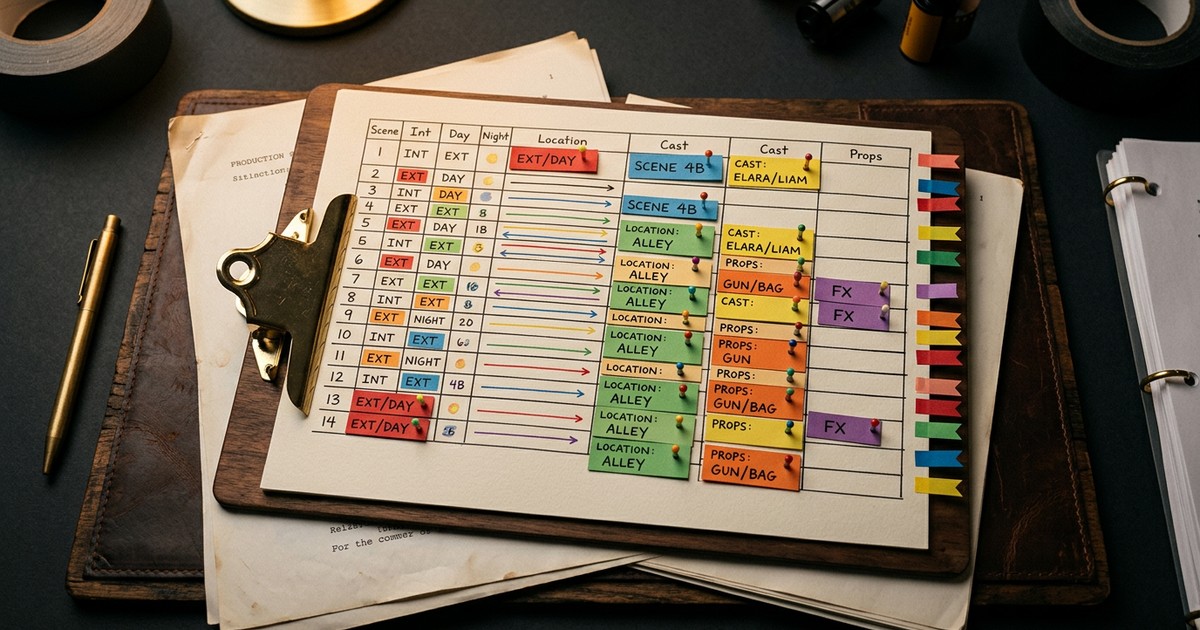
Before a single frame is shot, every script must be dismantled. A script breakdown sheet isolates every physical element required for a scene, transforming a creative narrative document into a strict logistical roadmap.
Missing a single prop, background actor, or stunt requirement during this phase causes expensive delays on set. If the prop master doesn't know a character needs a specific watch, the camera cannot roll. The breakdown process ensures that every department head knows exactly what is expected of them on any given shoot day.
The Anatomy of a Script Breakdown Sheet
Historically, breakdowns were done with rulers, highlighters, and printed scripts. Today, digital tools handle the formatting, but the underlying logic remains identical. You break the script down scene by scene.
Each breakdown sheet represents a single scene. The header contains vital metadata: the scene number, whether it takes place inside or outside (INT/EXT), the time of day (DAY/NIGHT), the setting, and the page count. Page counts are traditionally measured in eighths of a page (e.g., 1 3/8 pages). This helps the assistant director estimate how long the scene will take to film.
Below the header, the sheet is divided into specific category boxes. Every physical item or person mentioned in the scene's action lines or dialogue is tagged and placed into one of these boxes.
Element by Element: What You Need to Tag
Cast
Every speaking character in the scene falls into this category. In a traditional manual breakdown, cast members are underlined in red.
The assistant director uses this list to create a Day Out of Days (DOOD) report, which schedules when actors are needed on set. Tagging cast accurately is critical for managing holding fees, turnaround times (the mandatory rest period between wrap and the next day's call time), and strict labor laws regarding child actors.
Background Actors / Extras
Background actors populate the world. They do not have speaking lines. They are traditionally underlined in green.
Tagging background actors dictates multiple departmental logistics. The wardrobe and makeup departments need headcounts to prep background holding areas. The production team must arrange adequate catering, holding tents, and transport. You also need to specify demographics, uniform requirements (like police officers or medical staff), and whether they bring their own props.
Props
Props are items that actors physically handle or interact with. They are traditionally underlined in purple.
The property master relies heavily on these tags. If a character drinks a beer, the prop department must source the bottle, create fake labels to avoid trademark issues, and provide non-alcoholic liquid. Crucially, props often require "multiples." If a character smashes a plate, the prop master needs ten identical plates for multiple takes. If a prop is used as a weapon, the armorer must provide a safe rubber version (a "stunt prop") alongside the "hero prop" used for close-ups.
Wardrobe / Costumes
Specific costume requirements noted in the script are highlighted with a circle.
The costume designer uses this to track script days and continuity. If a script notes that a character's jacket gets torn in scene 12, the wardrobe department must have multiple identical jackets in various stages of distress for filming out of order. They also need to know if an actor is performing a stunt so they can size costumes up to hide safety pads underneath.
Makeup & Hair
Makeup and hair notes are highlighted with an asterisk.
This goes beyond standard daily makeup. You must tag continuity elements like a black eye that slowly heals over the course of the film, specific tattoos, dirt, sweat, or elaborate prosthetics. Special effects makeup (SFX makeup) requires significant prep time. If a character is tagged with a severe wound, the actor's call time might be pushed three hours earlier just to sit in the makeup chair.
Vehicles
Vehicles appearing on screen—known as picture cars—are underlined in pink.
The transportation department must source vehicles that match the era, aesthetic, and budget. Beyond just acquiring the car, vehicles dictate camera gear. If an actor is driving, the grip department needs to know if they are towing the car on a process trailer or rigging cameras directly to the hood.
Animals
Animals are underlined in brown.
Working with animals changes the pace of a set. Tagging an animal means production must hire specialized wranglers, adhere to strict safety and humane society guidelines, and schedule closed-set protocols. Like props, animal roles often require multiples—one dog trained to run, another trained to sit quietly, both playing the same character.
Special Effects (SFX)
Practical special effects happening in the physical space of the set are underlined in blue.
This includes atmospheric smoke, rain machines, practical fire, squibs (blood hits), and explosions. SFX requires specialized technicians, local fire department permits, and extensive safety meetings. Tagging this early prevents production from scrambling to find an available hazmat crew or water truck at the last minute.
Special Equipment
Camera and grip equipment that goes beyond the standard package is highlighted with a box.
If the script implies a sweeping aerial shot, you tag a drone. If it follows a character walking down five flights of stairs, you might tag a Steadicam. Underwater housings, techno-cranes, and motion-control rigs all go here. Identifying these early ensures the production rents the gear only for the days it is actually needed, saving thousands of dollars.
Stunts
Physical action requiring coordination is underlined in orange.
Fights, falls, precise driving, or wirework require a stunt coordinator. Even seemingly simple actions, like a character tripping over a rug, should be tagged as a stunt. This ensures the production schedules rehearsal time, hires stunt doubles, procures safety mats, and conducts mandatory safety briefings before the camera rolls.
Locations and Set Dressing
While locations are in the scene header, specific set dressing notes within the action lines must be tracked. Set dressing includes items in the environment that the actors do not physically use.
The location manager uses this information to secure clearances, ensuring a space can handle the physical footprint of the crew. The art director and set decorator use set dressing tags to build the visual identity of the room, sourcing furniture, artwork, and window treatments.
Sound and Music
Sound elements required practically on set are tagged here.
If a scene features characters dancing in a club, production needs a "thump track" to keep the beat while allowing dialogue to be recorded clearly. If a character reacts to a specific sound—like a doorbell or a gunshot—the sound mixer might need to play it back live. Wild lines (dialogue recorded without the camera rolling) are also noted here.
The Boundary Lines: Props vs. Set Dressing vs. Wardrobe
One of the most common mistakes when breaking down a script is confusing props, set dressing, and wardrobe. Assigning an item to the wrong department causes friction on set.
| Element | Definition | Example | Responsible Department |
|---|---|---|---|
| Prop | An item an actor intentionally handles or uses. | A coffee mug picked up to take a drink. | Property Master |
| Set Dressing | An item that exists in the environment but is untouched. | A coffee mug sitting on a background desk. | Set Decorator / Art |
| Wardrobe | Clothing or accessories worn normally. | A wristwatch worn to tell time. | Costume Designer |
| Crossover Prop | An item worn, but used actively as a tool. | A wristwatch used to deflect a laser beam. | Props & Costumes (Shared) |
Traditional Color Coding Guide
If you are working with physical scripts or standard breakdown software, memorizing the traditional color codes keeps your work aligned with industry standards:
- Red: Cast (Speaking Roles)
- Green: Background Actors / Extras
- Purple: Props
- Circle: Wardrobe / Costumes
- Asterisk: Makeup & Hair
- Pink: Vehicles
- Brown: Animals
- Blue: Special Effects (SFX)
- Box: Special Equipment
- Orange: Stunts
Adapting Film Techniques for Digital Content
Even solo digital creators are adopting these traditional film techniques. When figuring out https://narratora.com/blog/how-to-write-a-youtube-script, noting your props and locations early prevents delays on shoot day. Using a solid https://narratora.com/blog/youtube-script-template often includes dedicated space for these technical requirements, forcing you to think logistically before you hit record.
The transition from colored pencils to digital tagging is a perfect example of https://narratora.com/blog/what-is-content-automation, allowing producers to focus on logistics rather than drawing circles on paper. For those managing early conceptual phases, tapping into resources like a https://narratora.com/free-ai-prompt-library can accelerate visual research and lookbook creation before the formal breakdown even begins.
Modernize Your Script Breakdown
Manual highlighting is tedious, prone to human error, and takes days to complete. Narratora’s Production Script Breakdown workflow modernizes this entirely. You simply upload your script, and the platform automatically reads, analyzes, and tags every cast member, prop, vehicle, and stunt, generating a comprehensive breakdown in minutes. There are no prompt-building forms or complicated settings—just give Narratora what you have, and it figures out the rest. Ready to streamline your pre-production and get to set faster? Click here to start your trial.
Turn your sources into content like this
Narratora builds publish-ready scripts, briefs, and reports from your uploaded material.
Start Your 5-Day Trial — $1/Day