
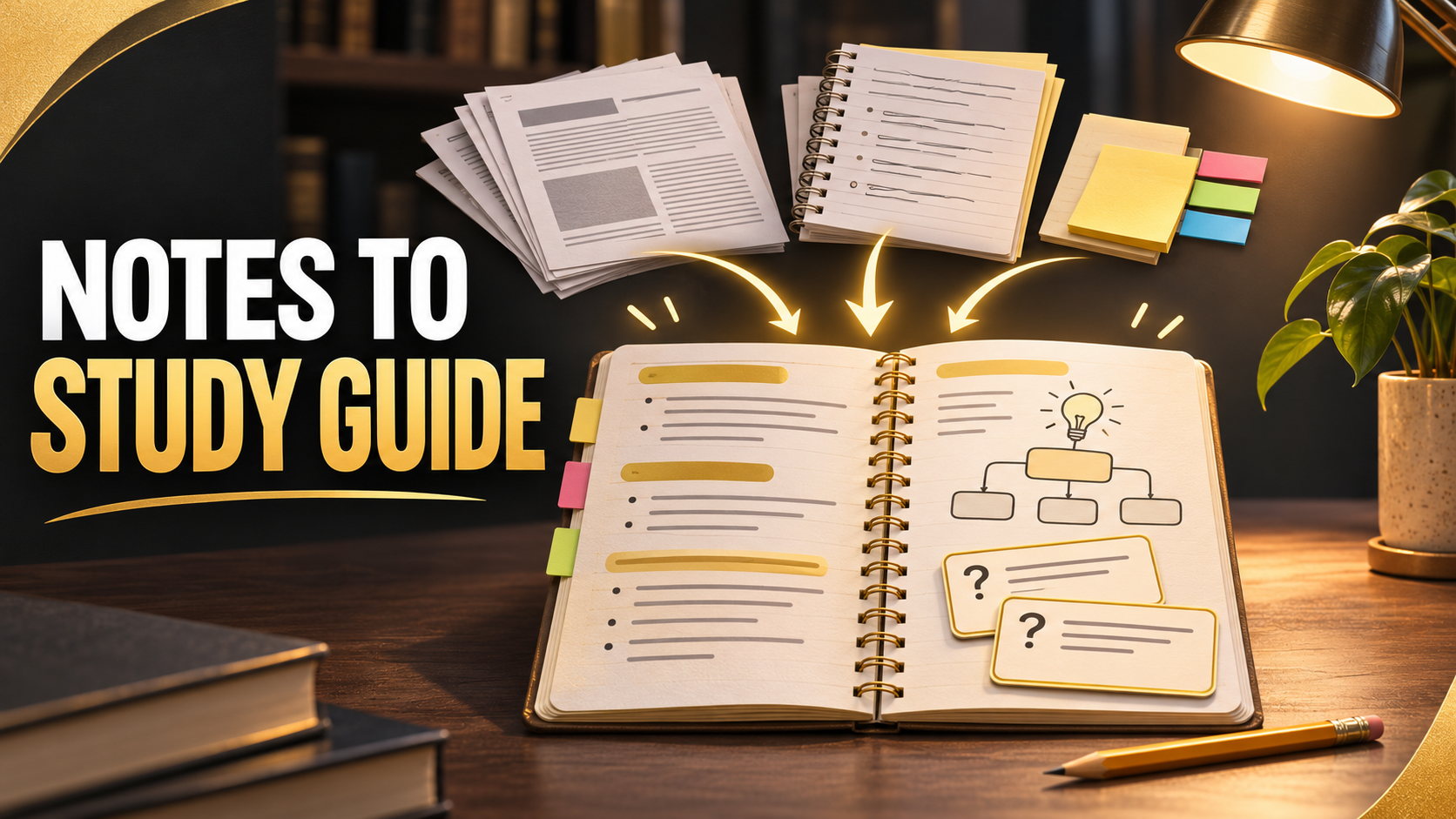
How to Turn Research Papers and Lecture Notes Into Study Guides
Build a study guide from research papers and lecture notes. Organize concepts, preserve evidence, create practice questions, and review the generated draft.
Your notes contain definitions. The research paper contains evidence. The assignment asks you to compare, explain, or apply the ideas.
A shorter version of the reading may help you navigate it, but your study guide also needs to prepare you to use the material.
Build a study guide by mapping the required topics, organizing explanations and evidence, and adding questions you can answer without looking at the source.
Then check the answers and return to the material where your understanding is incomplete.
AI can help organize the first pass. Your learning comes from how you review and use it.
Decide what you are preparing to do
Start with the course objectives, assignment, seminar question, or your own learning purpose.
A research discussion requires a different guide from a terminology test.
| Task | Guide emphasis |
|---|---|
| Explain a concept | Definition, mechanism, example, and limits |
| Compare theories | Shared question, differences, evidence, and implications |
| Evaluate a paper | Research question, method, findings, and limitations |
| Solve problems | Conditions, procedure, reasoning, and checked examples |
| Prepare for discussion | Argument, evidence, questions, and alternative interpretations |
Keep the instructor’s requirements as the reference where one exists.
A generated guide cannot establish the assessment scope unless that scope is supplied and verified.
Gather the right source material
Collect lecture notes, assigned readings, relevant slides, and any permitted supporting material.
Label each source.
Include course week or topic, document title, author, and the relevant pages or sections.
A lecture note may simplify a theory for teaching. A paper may investigate a narrow question within that theory.
Preserve the distinction.
If a passage in your notes is unclear, mark it as a question instead of allowing the guide to treat it as a settled statement.
Create a coverage map
List the topics you need to understand and where they appear.
| Topic | Lecture material | Reading | Status |
|---|---|---|---|
| Core definition | Week two | Introductory section | Needs checking |
| Proposed mechanism | Week three | Discussion | Partly understood |
| Evidence | Seminar notes | Results | Review required |
| Limitation | Mentioned briefly | Methods and discussion | Needs explanation |
This example uses placeholders.
The map helps you spot missing topics and overrepresented material.
A long guide can still omit an important learning objective. Review coverage before polishing the wording.
Read research papers through their questions and methods
For each paper, identify what the researchers asked, what they did, what they found, and how far the findings support the conclusion.
Record the population, setting, measurements, and limitations where relevant.
Avoid reducing the paper to its abstract alone.
A statement in the discussion may be an interpretation. A proposed future application may go beyond what the study directly tested.
Purdue OWL’s active-reading resources encourage attention to research methods, findings, and how authors develop their conclusions. Active reading resource
Write the guide so those distinctions remain visible.
Use plain explanations without losing conditions
Translate dense language into a form you can explain.
Then compare the simplified statement with the original.
Check whether you dropped an important qualifier, boundary, exception, or relationship.
For example, a finding about one group under one condition should retain that context.
A useful guide can include a short explanation followed by the condition under which it applies.
Keep precise technical terms where the course requires them, and explain them alongside the plain-language account.
Turn headings into retrieval questions
A heading such as “Working memory” tells you where information belongs.
A question such as “How does working memory differ from long-term memory in the model taught this week?” asks you to produce an answer.
University learning resources support retrieval practice and studying across separate sessions as useful strategies. The practical implication is to attempt an answer, check it, and revisit the material later. UC San Diego study guidance
Use several question types.
-
Define the idea.
-
Explain how it works.
-
Compare it with another concept.
-
Apply it to a new example.
-
Identify a limitation.
-
Explain what evidence would challenge an interpretation.
Keep answer material separate enough that you can test yourself.
Include examples you can explain
An example should illuminate the concept’s mechanism.
If you cannot explain why it fits, keep it as a question for further review.
Use an example from class when appropriate, then construct a new one and check it.
For a theory comparison, ask how each theory would interpret the same situation.
That exercise can reveal a difference you missed while reading.
Label invented examples so they are not confused with actual study findings.
Generate a first pass with Narratora
Organizing several readings and pages of lecture notes requires repeated extraction and structuring.
Narratora’s Study Guide workflow helps turn source material into organized study content.
Its official Help Center confirms supported document input and lists Study Guide among the available premium outputs. Review the generated content against your course materials. Narratora Help Center
-
Upload the relevant papers and notes.
-
Describe the source context accurately where available.
-
Select Study Guide through the appropriate workflow.
-
Configure the available options.
-
Generate the first pass.
-
Check coverage against your topic map.
-
Verify definitions, examples, and answer material.
-
Add or refine the practice activities you need.
-
Use or export the reviewed guide.
The benefit is beginning with organized material rather than repeatedly restructuring the notes manually.
Inspect a Study Guide example and assess whether its organization supports the way you need to learn. Narratora Samples Library
Check questions and answers before using them
Generated questions can sound plausible while relying on an inaccurate premise.
For each important question, locate the source supporting its answer.
Check that the question is answerable, that the answer addresses it, and that alternatives are handled appropriately.
For calculations, verify the method and arithmetic independently.
For interpretive questions, distinguish a defensible answer from a single supposedly mandatory formulation.
If the material remains uncertain, ask the instructor or use an appropriate academic resource.
Study with the guide actively
Close the answer section and attempt a question.
Write or say the answer. Then compare it with the checked material.
Record what went wrong.
| Difficulty | Next action |
|---|---|
| Could not recall the term | Review and test again later |
| Recalled the term but could not explain it | Rebuild the explanation |
| Applied the wrong concept | Compare the conditions for each concept |
| Missed a limitation | Add a question targeting that boundary |
| Made a calculation error | Identify the mistaken step |
This record helps the guide evolve around your actual needs.
Repeatedly rereading the same page can make it feel familiar without showing whether you can produce the answer.
Revisit material across sessions
Schedule later checks rather than completing the guide once and setting it aside.
Use a short set of questions from several topics.
Spend more attention on errors and uncertain explanations, while continuing to test material you previously answered.
University of Toronto Scarborough’s learning guidance describes retrieval, spacing, elaboration, and concrete examples as strategies learners can apply. Learning strategies
Adapt the schedule to the course and your available time.
The guide should support practice across sessions.
Keep academic requirements visible
Check the course’s rules for AI use and sharing material.
A private study aid, an assessed response, and a distributed class resource may have different requirements.
Keep sources and attribution with the guide. Identify generated or adapted material where the relevant rules require it.
Do not present a generated answer as your own assessed work where that would violate the assignment’s instructions.
Use the guide to support understanding and preparation.
Frequently asked questions
Is a summary enough for studying?
A summary helps navigation. Add activities that require recall, explanation, comparison, or application according to the task.
Can I combine lecture notes and research papers?
Yes, while preserving the role and source of each claim. Check that a simplified teaching account has not replaced the paper’s conditions.
Can AI-generated questions be wrong?
Yes. Verify premises and answers against the material before relying on them.
Will a study guide guarantee a better grade?
Outcomes depend on the assessment, understanding, practice, and other factors. Use the guide as part of an active learning process.
Turn your materials into something you can study with
Try Narratora’s Study Guide with your notes and readings, then verify the first pass and use it for active practice.
The $5 five-day trial includes 40 credits and two premium outputs of your choice. It converts to a paid plan on day six unless canceled beforehand, with Max at $69 per month as the default. Start your trial
Sources
Add Narratora as a preferred source on Google
Tell Google you want our guides and tools first. Preferred sources show up higher in Top Stories, AI Mode and AI Overviews for you.
Add on GoogleTurn your sources into content like this
Narratora builds publish-ready scripts, briefs, and reports from your uploaded material.
Start Your 5-Day Trial — $1/Day