
How to Break Down a Screenplay for Scheduling and Budgeting
A screenplay is a story blueprint, but a script breakdown turns it into a manufacturing plan. Learn how tagging script elements drives your shooting schedule and dictates your production budget.
A screenplay is a blueprint for a story, but it is not a manufacturing plan. To actually build the movie, you have to tear the script apart into its core components. That process is the script breakdown. A thorough breakdown identifies every physical, logistical, and personnel requirement embedded in the text, setting the foundation for your production schedule and your budget. Without it, you are guessing on your shoot days and flying blind on your costs.
What is a Script Breakdown?
At its core, a script breakdown is the process of converting narrative prose into raw data. You read the screenplay line by line, identifying every single element required to shoot each scene. These elements are categorized and explicitly tagged.
Historically, this was done with physical scripts, rulers, and a standardized set of colored highlighters. Cast members were highlighted in red, props in purple, sound effects in brown, and special effects in blue.
Beyond tagging elements, the breakdown measures scene length. Screenplays are measured in eighths of a page (1/8). This measurement helps the First Assistant Director (1st AD) estimate how long a scene will take to shoot. A scene that is 1/8 of a page might take an hour to complete; a complex dialogue-heavy scene that runs 3 4/8 pages could take a full day.
This process requires deep comprehension of the material. You cannot simply search a document for nouns. A character mentioning a "loaded gun" in casual dialogue requires a completely different logistical response than a character actually firing one on screen. Recognizing these nuances requires reading for reality, and much like working with modern software, context is the real key to getting accurate data out of your script.
Building the Schedule: From Elements to Shoot Days
A screenplay is written in chronological order, following the emotional journey of the characters. A production schedule ignores narrative flow entirely. The goal of the schedule is maximum logistical efficiency. Moving a film crew—which can consist of 50 to 200 people—is incredibly expensive and time-consuming. You want to move them as little as possible.
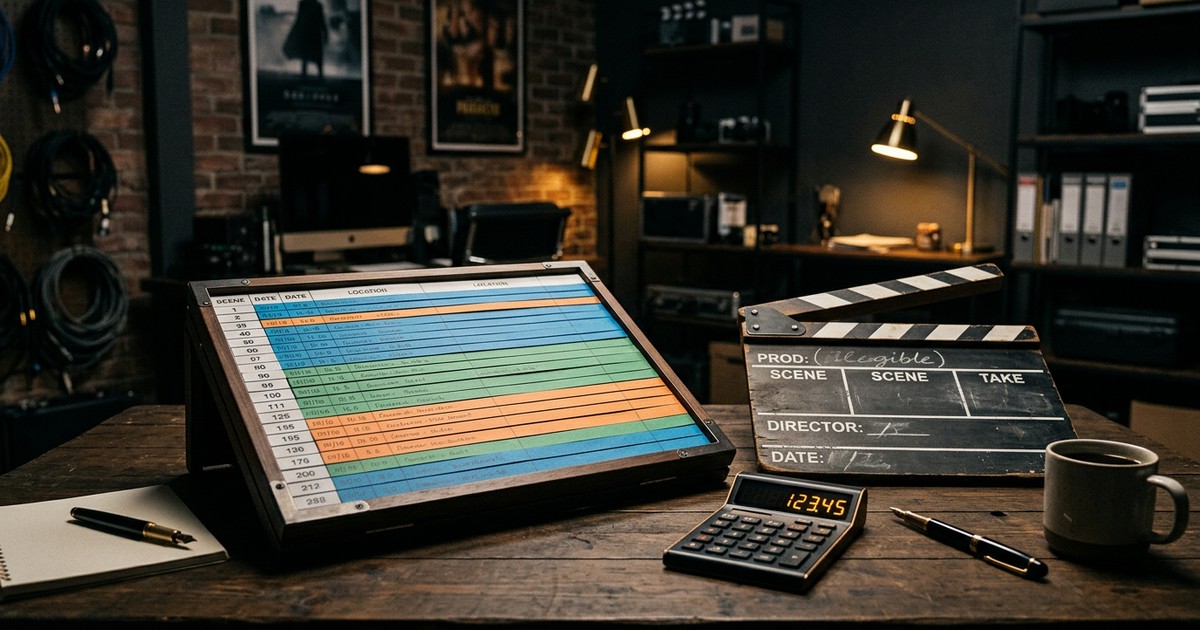
The data pulled during the breakdown populates the strip board (or production board). Every scene becomes a "strip" containing its critical metadata: Scene Number, I/E (Interior/Exterior), D/N (Day/Night), Location, Cast IDs, and Page Length.
The 1st AD organizes these strips based on specific logistical priorities:
Grouping by Sets and Locations
If your script features a coffee shop in Scene 5, Scene 42, and Scene 91, you do not visit the coffee shop three times. You schedule those scenes on the same day. The breakdown makes it immediately obvious which scenes belong to which physical location.
Sorting by Interior/Exterior and Day/Night
Exterior shoots are at the mercy of the weather and the sun. Exterior Night shoots are notoriously grueling, requiring massive lighting setups to illuminate dark spaces. Interior shoots, by contrast, are highly controlled environments.
A standard scheduling practice is to prioritize exteriors early in a shoot or when weather forecasts are favorable. Interiors are often kept in reserve as "cover sets"—locations the crew can pivot to if a sudden rainstorm ruins an exterior day. The breakdown clearly delineates these environments so the AD can build a weather-resilient schedule.
Managing Cast Availability
Actors are typically paid on daily or weekly contracts. If a supporting actor has scenes scattered randomly throughout the script, the production cannot afford to keep them on payroll for the entire two-month shoot. The breakdown assigns character IDs to every scene, allowing the AD to group a specific actor's scenes into a condensed window, saving the production thousands of dollars in talent hold fees.
Budgeting: Translating Element Counts into Dollars
While the 1st AD uses the breakdown to build the schedule, the Line Producer uses it to build the budget. Every tag applied during the breakdown process represents a line item that costs money.
Speaking Roles and Background Extras
Every speaking role requires a contract, a trailer, wardrobe, and makeup. Background actors (extras) also drive massive logistical costs. If a scene description reads "a packed concert hall," the breakdown flags the need for 500 background actors. That means 500 daily rates, 500 meals to cater, and an army of wardrobe assistants to dress them.
Props, Wardrobe, and Vehicles
The breakdown differentiates between general set dressing and specific props. A "messy desk" is handled generally by the art department. But if a character picks up a "vintage 1970s tape recorder," that is a specific prop that must be sourced, rented, and cleared for use. Picture cars—vehicles seen on screen—require specialized wranglers, transport, and specific insurance riders.
Stunts, Special Effects (SFX), and Visual Effects (VFX)
Action lines in a script can be deceptively simple. "The car crashes into the wall" is only seven words, but in a breakdown, it translates to a massive financial undertaking. It requires stunt drivers, safety coordinators, paramedics on set, multiple identical vehicles, and likely a VFX supervisor to oversee the clean-up in post-production. The Line Producer relies entirely on the breakdown to catch these requirements before the budget is locked.
The Cascade Effect of Breakdown Errors
Pre-production is a fragile ecosystem. An error made during the script breakdown does not stay in the breakdown—it cascades directly into the schedule and the budget, usually resulting in expensive disasters on set.
Consider what happens if a breakdown misses a critical element:
- Missed specialized equipment: A scene requires a high-angle shot from a third-story window, but the breakdown missed the need for a condor crane. On the day of the shoot, the director realizes they cannot get the shot. The production must either compromise the creative vision or halt shooting, losing tens of thousands of dollars in wasted crew time while they scramble to rent the equipment.
- Underestimating page length: A highly emotional, dialogue-heavy scene is miscalculated in the breakdown as a quick half-page sequence. The schedule allocates two hours to shoot it. On set, it takes eight hours. The schedule falls behind, pushing other scenes to subsequent days, forcing the production into expensive overtime or requiring an additional, unbudgeted shoot day.
- Child actor labor laws: A scene features a child actor, but the breakdown fails to flag their presence across multiple night shoots. Labor laws heavily restrict the hours minors can work, especially at night. The production is suddenly forced to rewrite the schedule on the fly, disrupting cast availability and location rentals.
Connecting the Dots: Elements, Schedule, and Budget
To understand how tightly these three phases of pre-production are linked, look at how a single script element ripples through the production office.
| Script Element | Scheduling Impact | Budgeting Impact |
|---|---|---|
| Cast (Day Players) | Group scenes to minimize the number of shoot days required. | Daily SAG-AFTRA rates, travel, and accommodation costs. |
| Background Extras | Isolate massive crowd scenes to specific days to manage logistics. | Background rates, wardrobe rentals, and increased catering volume. |
| Special Equipment | Group shots requiring cranes or Steadicams to avoid multiple rental periods. | Daily rental fees and rates for specialized union operators. |
| Visual Effects (VFX) | Allocate extra on-set time for shooting clean plates and tracking markers. | Pre-viz costs, on-set supervisors, and extensive post-production budgets. |
| Exterior Night | Requires overnight scheduling, which dictates crew turnaround times. | Overtime, night premiums, and extensive lighting and generator rentals. |
Modernizing the Production Office
For decades, breakdowns were a brutally manual process. Producers and ADs spent days locked in offices with stacks of paper and highlighters. Today, the industry is shifting toward more intelligent workflows.
Much like the shift we see in digital marketing when companies ask what is content automation, the goal in film pre-production is not to replace human decision-making, but to accelerate it. When a production team doesn't have to spend three days manually circling props with a red marker, they can spend that time doing what they do best: negotiating better vendor rates, optimizing the shooting schedule, and solving complex logistical puzzles.
Even smaller administrative tasks around the production office are becoming streamlined. Independent producers frequently use an AI prompt library to help draft initial casting calls, location scout emails, or crew deal memos, freeing up more bandwidth for the actual breakdown and scheduling strategy.
Best Practices for a Bulletproof Breakdown
Whether you are working on a massive studio feature or a micro-budget indie, adhering to strict breakdown practices will protect your production.
- Read for story first: Never start tagging elements on your first read. Read the script entirely as a narrative experience to understand the director's intent, the tone, and the pacing. Only on the second read should you put your producer hat on.
- Standardize your categories: The film industry uses universal color codes for a reason. Stick to them. Cast is red, Props are purple, Background Extras are green. Standardization ensures that anyone who picks up your breakdown can instantly understand the logistics.
- Consolidate elements meticulously: Writers are notoriously inconsistent with character and location names. A character might be introduced as "Police Officer 1" but referred to as "Officer Davis" later in the script. Map them to a single character ID in your breakdown so you don't accidentally hire two actors for one role.
- Question the text: "A dog barks in the distance." Does the production actually need a dog on set, or will that be added as a sound effect in post-production? A good breakdown clarifies these ambiguities with the director before the budget is finalized.
From Script to Screen: Production Script Breakdown
A flawless breakdown is the absolute requirement for an accurate schedule and a responsible budget. Instead of spending days manually highlighting pages, Narratora allows you to upload your screenplay and immediately generate a comprehensive Production Script Breakdown. The platform automatically reads your text, identifies the context of every scene, and tags every production element—from cast and props to specialized vehicles and VFX. Focus your time on planning your shoot, not pushing paper. You can start your trial today and see how fast your pre-production can move.
Turn your sources into content like this
Narratora builds publish-ready scripts, briefs, and reports from your uploaded material.
Start Your 5-Day Trial — $1/Day